|
TRUST 1.9.8
HPC thermohydraulic platform
|

|
TRUST 1.9.8
HPC thermohydraulic platform
|
Unlike PolyMAC_CDO, PolyMAC_MPFA does not introduce the vorticity and does not require an explicit complex dual mesh. It is built on the Multi-Point Flux Approximation (MPFA) family of methods. The location of the unknowns is shown below.
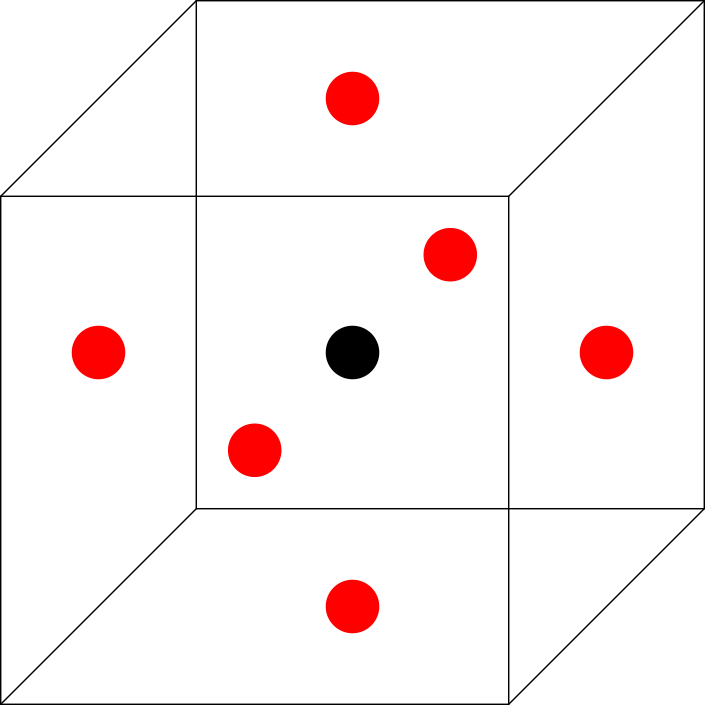
In the TRUST class hierarchy, Domaine_PolyMAC_MPFA and its operators inherit from their PolyMAC_HFV counterparts: the only ingredient that genuinely uses an MPFA reconstruction is the face-flux operator built by Domaine_PolyMAC_MPFA::fgrad. The convection operator, the mass solver and most of the Navier-Stokes machinery are inherited unchanged from PolyMAC_HFV.
| Field | Location |
|---|---|
| Scalar (T, p, α, ...) — Champ_Elem | One value per cell |
| Velocity — Champ_Face | Normal component at each face + auxiliary tangential vector at each cell |
The cell-tangential auxiliary DOFs are reconstructed from the face-normal values after every linear solve (see Cell-tangential velocity reconstruction below). They are not independent unknowns.
Three MPFA schemes are implemented:
To build the sub-cell geometry on which the gradient is reconstructed, the procedure is:
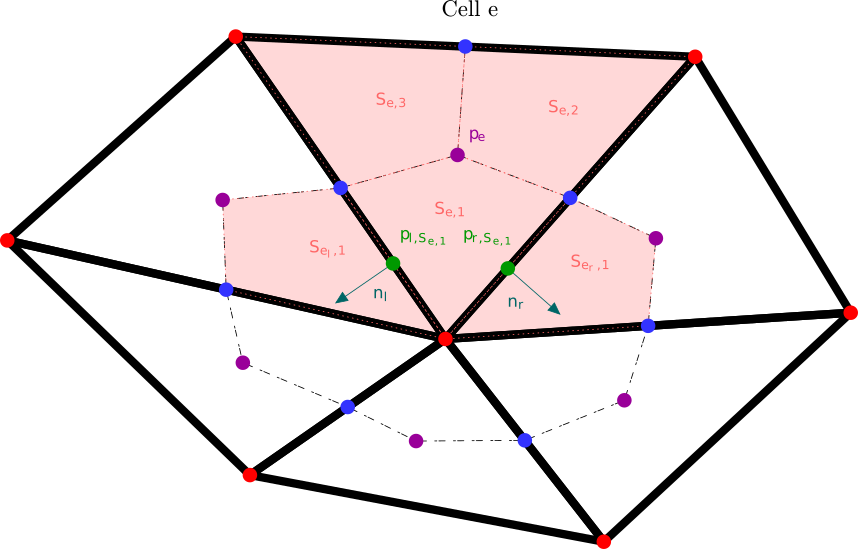
On sub-volume \(S_{e,i}\) the gradient of a potential \(p\) is
\[G_{S_{e,i}}([p]_e) = \frac{1}{|S_{e,i}|}\sum_{f' \subset \partial S_{e,i}} (u_{f'_s} - p_e)\,\vec{n}_{f'} \]
with \(\vec{n}_{f'}\) outward unit normals, assembled cell-by-cell as
\[G^{\text{MPFA}}_{|S_{e,i}} = G_{S_{e,i}}([p]_e),\qquad \forall e \in E,\; i \in S_e. \]
Continuity of the normal flux across each interior sub-face yields a small dense linear system relating the trace unknowns \(u_{f_v}\) to the cell unknowns \(u_e\). This system is solved (LAPACK DGELSY) and the trace unknowns are eliminated, leaving for each face \(f\) a multi-point coefficient array phif_c(f, e_s) such that
\[[\vec{n}_f \cdot \nu \nabla u]_f \;\approx\; \sum_{e_s \in \mathrm{stencil}(f)} \texttt{phif\_c}(f, e_s)\,u_{e_s}. \]
In TRUST the loop in fgrad is over mesh vertices: at each vertex, the small dense system above is built using the fan of incident cells and faces, and the result is accumulated into the global face stencil. For each vertex the three schemes are tried in order (MPFA-O → MPFA-O(η) → MPFA-symm); a candidate is accepted as soon as the smallest eigenvalue of the local symmetric bilinear form (DSYEV) satisfies
\[\lambda_{\min} > -10^{-8}\,|v| \]
where \(|v|\) is the volume of the vertex sub-region. MPFA-symm is therefore invoked only as a fallback at vertices where both MPFA-O and MPFA-O(η) fail the coercivity test — typically in locally distorted or anisotropic regions of the mesh. At the first call of fgrad, the percentages of vertices using each scheme are printed, e.g.:
A high MPFA-SYM share does not necessarily indicate a numerical problem, but it tells the user where to look if the local convergence rate degrades: those are the vertices at which strong consistency had to be abandoned for guaranteed coercivity.
fgrad carries an is_p flag that swaps the role of Dirichlet and Neumann boundary conditions inside the local solve, so the same routine reconstructs \([\vec{n}\cdot\nabla p]_f\) for the pressure-velocity coupling and \([\vec{n}\cdot\nu\nabla u]_f\) for diffusion without duplicate code.
Op_Diff_PolyMAC_MPFA_Elem discretises
\[|e|\,\varphi_e\,\partial_t u_e \;-\; \sum_{f \in F_e} \sigma_{e,f}\,|f|\,[\vec{n}_f \cdot \nu \nabla u]_f \;=\; |e|\,s_e, \]
where \(\sigma_{e,f} = \pm 1\) depending on face orientation. The face flux is the multi-point combination delivered by fgrad. On a K-orthogonal mesh the stencil collapses to the two-point TPFA pattern and recovers the classical orthogonal-mesh FV scheme; the percentage of faces where this collapse happens is printed by Op_Diff_PolyMAC_MPFA_Elem::dimensionner_blocs as a useful diagnostic of effective mesh orthogonality.
The same machinery is used by Op_Diff_PolyMAC_MPFA_Face for the viscous block of the momentum equation, applied componentwise to each scalar component of velocity.
\[\begin{aligned} \rho\varphi\,\partial_t u + \rho\,\nabla\cdot(u\otimes u) + \nabla p - \nabla\cdot\bigl(\nu(\nabla u + (\nabla u)^\top)\bigr) &= \rho f, \\ \nabla\cdot u &= 0. \end{aligned} \]
Mass equation — discretised at the cell using Green-Ostrogradski:
\[|e|\,[\nabla\cdot u]_e = \sum_{f \in F_e} \sigma_{e,f}\,|f|\,[u]_f. \]
The face-normal flux depends only on face-normal velocities, which is the structural reason PolyMAC inherits the MAC-scheme div-free property on Cartesian meshes.
Convective term — Op_Conv_EF_Stab_PolyMAC_MPFA_Face is face-based: at each face \(f\), the contribution of cell \(e\) is
\[\frac{|f|\,u_f\,\varphi_e}{2}\,\bigl(1 + \alpha\,\mathrm{sgn}(u_f)\bigr)\,u_e,\qquad \alpha \in [0, 1], \]
where \(\alpha\) blends pure upwind ( \(\alpha = 1\), exposed as Op_Conv_Amont_PolyMAC_MPFA_Face) and pure centred ( \(\alpha = 0\), exposed as Op_Conv_Centre_PolyMAC_MPFA_Face). The transport velocity used is the previous-iterate value \(u^{\text{old}}\) (Picard linearisation). On non-orthogonal meshes the cell-tangential auxiliary DOFs enter via a face-to-cell projection that uses the second-order velocity reconstruction described below.
Diffusive term — \(\nabla\cdot\bigl(\nu(\nabla u + (\nabla u)^\top)\bigr)\) is treated componentwise: each scalar component \(u^d\) is fed to fgrad with the diffusivity \(\nu\), and the resulting face flux feeds the viscous block. The reduction \(\nabla\cdot\bigl(\nu(\nabla u + (\nabla u)^\top)\bigr) = \nu\Delta u\) holds only when \(\nu\) is constant and \(\nabla\cdot u = 0\) holds discretely; the implementation keeps the full Newtonian stress form so that variable viscosity is handled correctly.
The viscous flux at a face needs the velocity vector at the adjacent cell barycenter — not only the face-normal component. The cell-tangential auxiliary DOFs \(u_e^d\) carry this information, but they are not independent unknowns: after every linear solve, Masse_PolyMAC_MPFA_Face::corriger_solution overwrites them via a least-squares reconstruction from the face-normal values:
Second-order reconstruction is what makes the viscous operator consistent on smooth solutions. The soft mass-matrix entry on the cell-tangential rows is numerical-conditioning glue only — the physical closure is update_ve2.
Op_Grad_PolyMAC_MPFA_Face reuses fgrad in pressure mode (is_p = 1). Two boundary regimes need care:
On walls and symmetry boundaries, pressure has no DOF and no externally-imposed value. The wall-trace value \(g_b(f) \approx p(x_f)\) is reconstructed from the discrete cell-tangential momentum equation of the wall-adjacent cell, by contracting it against \(\vec{n}_f / (|f|\,|e|)\):
\[g_b(f) \;\approx\; \frac{1}{|f|\,|e|}\sum_d n_f(d)\,\Bigl(R^d_e \;-\; L^d_e(u) \;-\; \text{(interior-face terms)}\Bigr). \]
This gb(f) is split into a constant part (gb, from the explicit RHS) and a velocity-dependent part (dgb_v_) folded back into the velocity block of the matrix at the end of the assembly — so that the wall-pressure trace is treated fully implicitly, preserving the second-order accuracy of MPFA-O up to the wall. The naive alternative (homogeneous Neumann \(\partial_n p = 0\)) would degrade to first order on non-uniform meshes.
Once fgrad is built, the discrete Poisson operator used by the projection step is
\[[\mathrm{div}\,\nabla p]_e \;=\; \sum_{f \in F_e} \sigma_{e,f}\,|f|\,\varphi_f\,[\vec{n}_f\cdot\nabla p]_f, \]
assembled in Assembleur_P_PolyMAC_MPFA. When the problem has no pressure reference (no Neumann_sortie_libre), the constant-pressure mode is pinned by doubling the (0, 0) entry on the first MPI rank carrying real cells.
| BC type | Handled in | Effect on the local system |
|---|---|---|
| Dirichlet | fgrad (trace eq) | hard-set \(u_{f_v} = u_b\); RHS gets \(\texttt{phif\_c}\cdot u_b\) |
| Neumann | fgrad (trace eq) | RHS gets \(+\|f_v\|\,\phi_{\text{imp}}\) |
| Echange_impose | fgrad (trace eq) | Robin-type coupling, RHS gets \(h\,T_{\text{ext}}\) |
| Frottement_*_impose | fgrad (trace eq) | friction term on the cell or face-trace column |
| Symetrie / outflow | implicit | nothing to add (zero coefficient) |
| Echange_contact_PolyMAC_MPFA | Op_Diff helper | vertex-level continuity across two problems via MEDCoupling; the only BC that produces off-problem matrix entries |
PolyMAC_HFV is based on a Hybrid Finite Volume (HFV) approach [11] [6] and is mathematically close to PolyMAC_CDO, since HFV and CDO methods are equivalent [6]. PolyMAC_MPFA differs from PolyMAC_HFV only in the face-flux reconstruction: the rest of the family (DOF layout, mass solver, convection operator, pressure assembly, multiphase support) is inherited from PolyMAC_HFV.
 1.16.1