|
TRUST 1.9.8
HPC thermohydraulic platform
|

|
TRUST 1.9.8
HPC thermohydraulic platform
|
Initially introduced in [23], Volume Élément Finis (VEF) is a variant of the standard finite element and finite volume methods. The formalism developed in [9] was subsequently used for the implementation of this method in TRUST.
Consider the following instationary problem with velocity \(\boldsymbol{u}\), flux term \(\boldsymbol{F}\) and source term \(\boldsymbol{S}\):
\[\partial_t \boldsymbol{u} + \nabla \cdot \boldsymbol{F} = \boldsymbol{S} \]
We introduce the control volume \(\omega_f\) (see figure below) in which we evaluate the velocity \(\boldsymbol{u}\), and integrate on \(\omega_f\) between times \(t^n\) and \(t^{n+1}\):
\[\int_{\omega_f} (\boldsymbol{u}^{n+1} - \boldsymbol{u}^n)\mathrm{d}\boldsymbol{V} + \int_{\partial\omega_f} \int_{t^n}^{t^{n+1}} \boldsymbol{F} \cdot \boldsymbol{n} \, \mathrm{d}\boldsymbol{s} = \int_{\omega_f} \int_{t^n}^{t^{n+1}} \boldsymbol{S} \, \mathrm{d}\boldsymbol{V} \]
For the Stokes equation: \(\boldsymbol{F} = \mu \nabla \boldsymbol{u} - p\boldsymbol{I}\). For the Navier-Stokes equation: \(\boldsymbol{F} = \mu \nabla \boldsymbol{u} - p\boldsymbol{I} + \rho \boldsymbol{u} \otimes \boldsymbol{u}\).
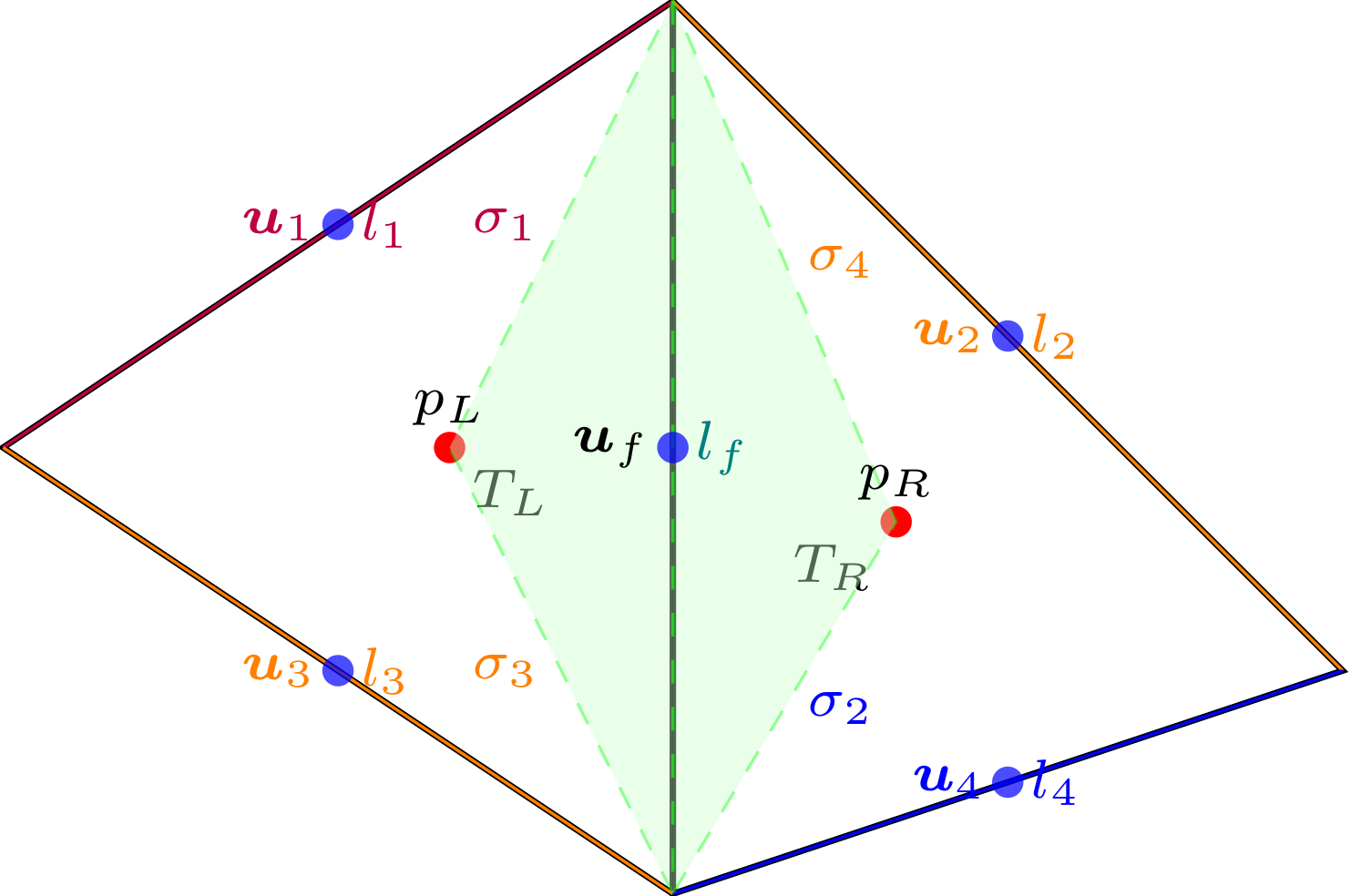
Given a tetrahedral mesh \(\mathcal{M}\), define points \(\boldsymbol{x}_f\) as the barycenter of face \(f\). The control volume \(\omega_f\) links the vertices of face \(f\) with the barycenters of the two cells \(e_1, e_2\) sharing that face. Discretizing the evolution term:
\[\int_{\omega_f} \boldsymbol{u}^{m} \mathrm{d}\boldsymbol{V} \approx |\omega_f| \boldsymbol{u}_f^m \qquad m \in \{n, n+1\} \]
The flux term discretization yields:
\[|\omega_f|(\boldsymbol{u}_f^{n+1} - \boldsymbol{u}_f^n) + \Delta t^{n,n+1} |l_f| (\boldsymbol{F}^m_{e_2} - \boldsymbol{F}^m_{e_1})\,\vec{n}_f = \Delta t^{n,n+1} \boldsymbol{S}_f^{n,n+1} \]
The VEF method uses the Crouzeix-Raviart basis: the full velocity vector is evaluated at the center of the faces of each cell, and within each cell the pressure is a constant at the cell center. Let \((\phi_f)_{f\in \mathcal{I}_F}\) be the velocity basis and \((\mathbb{I}_{e_k})_{k\in \mathcal{I}_E}\) the pressure basis:
\[\boldsymbol{u}_h = \sum_{f\in \mathcal{I}_F} \boldsymbol{u}_f \phi_f, \qquad p_h = \sum_{k\in \mathcal{I}_E} p_k \mathbb{I}_{e_k} \]
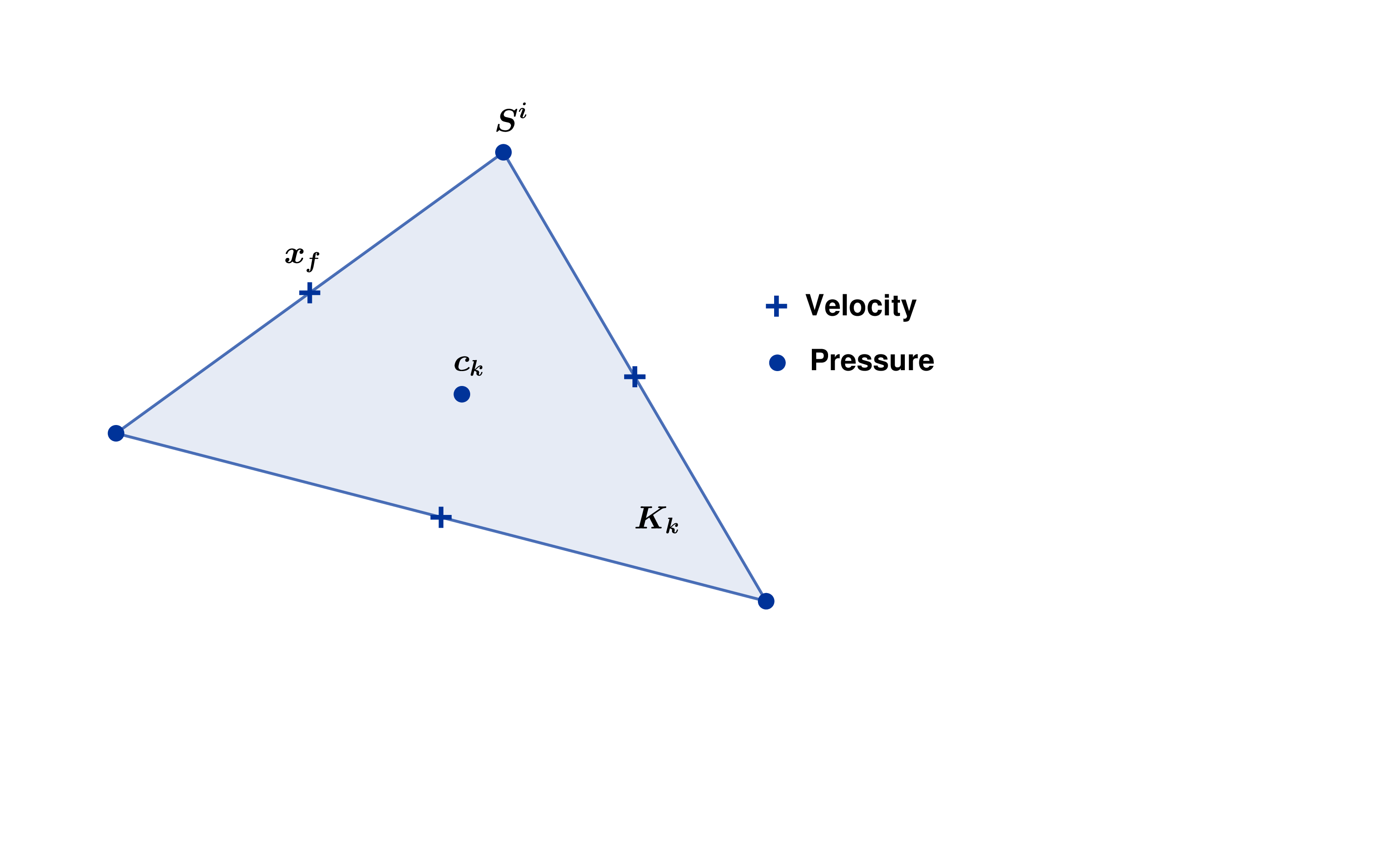
For the Stokes equation \(\boldsymbol{F} = \mu \nabla \boldsymbol{u} - p\boldsymbol{I}\), the discrete gradient writes:
\[\int_{\partial\omega_f} \boldsymbol{\nabla} \phi_{f'} \cdot \boldsymbol{n} \, \mathrm{d}\boldsymbol{s} = -\sum_{e \in \mathcal{M}} \frac{1}{|e|}\,\boldsymbol{S}_e^{f'} \cdot \boldsymbol{S}_e^f \]
and the pressure part:
\[\sum_{k \in \mathcal{I}_E} p_k \int_{\partial\omega_f \cap e_k} \boldsymbol{n} \, \mathrm{d}\boldsymbol{s} = |l_f|(p_{e_2} - p_{e_1})\,\vec{n}_f \]
Find \((\boldsymbol{u}_h, p_h) \in \mathbb{X}_h \times \overset{\circ}{\mathbb{N}}_h\) such that:
\[\left\{ \begin{aligned} \partial_t m_h^V(\boldsymbol{u}_h,\boldsymbol{v}_h) + a_h^V(\boldsymbol{u}_h, \boldsymbol{v}_h) + b_h^V(\boldsymbol{v}_h, p_h) &= L_h^V(\boldsymbol{v}_h) & \forall \boldsymbol{v}_h \in \mathbb{X}_h, \\ c_h^V(\boldsymbol{u}_h, q_h) &= 0 & \forall q_h \in \overset{\circ}{\mathbb{N}}_h. \end{aligned} \right. \]
According to [16], the scheme satisfies the following properties:
Spurious currents for low velocities can appear when using the VEF approach [12].
To reduce spurious currents (useful for low viscosities), a pressure-enriched basis was studied in [16] [12] and implemented in TRUST under the name VEF - \(\mathbb{P}^{nc}/\mathbb{P}^0+\mathbb{P}^1\).
The idea is to add pressure unknowns \(\mathbb{P}^1\) at the vertices of each cell, introducing a new control volume for the mass conservation. Two control volumes are used:
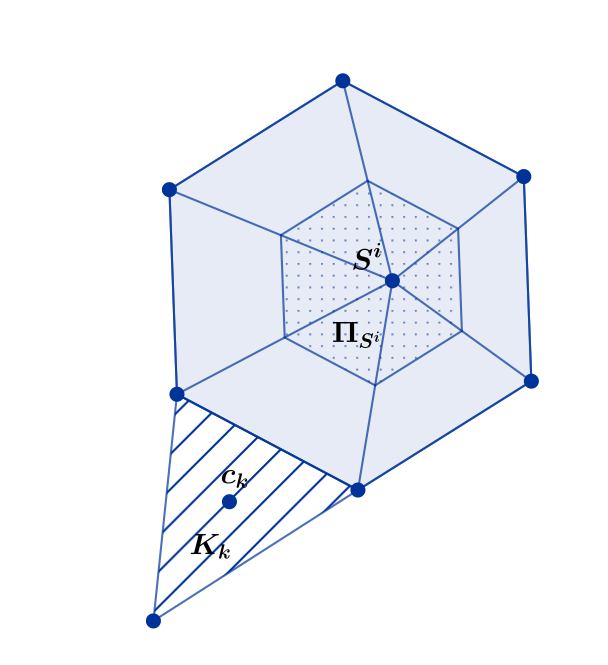
The stability of this basis is proved in [19] and the inf-sup condition in [12]. This scheme is the most widely used VEF discretization in TRUST.
 1.16.1