Setting Up the Environment
First, make sure the SALOME platform is installed and note its path, referred to here as $PathToSALOME. If you don't have SALOME installed, you can download it here.
Then, create a working directory and launch SALOME:
mkdir -p TRUST_TUTORIALS/salome/exo1
cd TRUST_TUTORIALS/salome/exo1
$PathToSALOME/salome &
Creating the Geometry
- Create a new study: File → New
- Select the Geometry module from the SALOME drop-down menu (which lists all available modules)
- Save your study frequently in HDF format (SALOME's native format)
- Create the cylinder:
- Go to: New Entity → Primitives → Cylinder
- Set Radius R = 100 and Height H = 300 (default values)
- Click "Apply and Close"
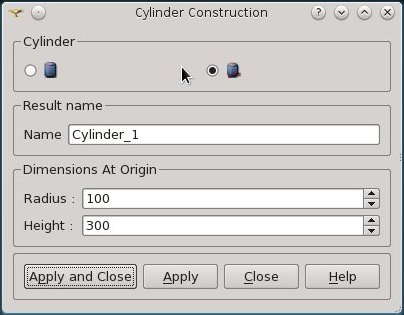
Cylinder creation dialog
- Navigate the view:
- Use the "Interaction style switch" (Mouse icon) to rotate, zoom, and pan the geometry
Defining Boundary Groups
To define boundaries for TRUST, we need to create groups for the top, bottom, and lateral surfaces:
- Create groups: New Entity → Group → Create Group
- Select Shape Type: Surface
- Create the "Inlet" group (top):
- Group Name: Inlet
- Click the arrow button in the Main Shape field
- Select "Cylinder_1" from the Object Browser or the visualization window
- Click on the top surface of the cylinder
- Click "Add" → "Apply"
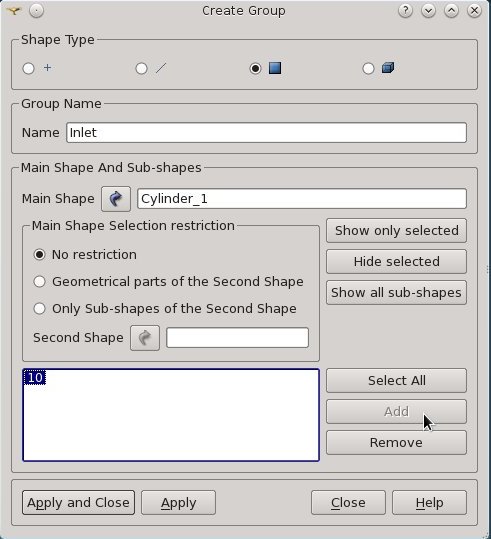
Creating boundary groups
- Create the "Wall" group (lateral surface):
- Repeat the process with Group Name: Wall
- Select the lateral surface
- Create the "Outlet" group (bottom):
- Group Name: Outlet
- Rotate the cylinder to access the bottom surface
- Select and add it
- Verify: Check that all three groups appear in the Object Browser (click the "▷" next to "Cylinder_1")
Creating the Mesh
- Switch to the Mesh module from the SALOME drop-down menu
- Display the geometry:
- Select "Cylinder_1" in the Object Browser
- Right Click → 'Show' (or click the eye icon)
- Create the mesh:
- Go to: Mesh → Create Mesh
- Select "Cylinder_1" as the geometry (if not already selected)
- Choose the "Netgen 1D-2D-3D" algorithm
- Click "Apply and Close"
- Compute the mesh:
- Select "Mesh_1" in the Object Browser
- Right Click → Compute (or Mesh → Compute)
- A table showing the number of triangles, quadrangles, etc. will appear
- Click "Close"
- Hide the geometry:
- Select "Cylinder_1" in the Object Browser
- Right Click → Hide (or click the eye icon)
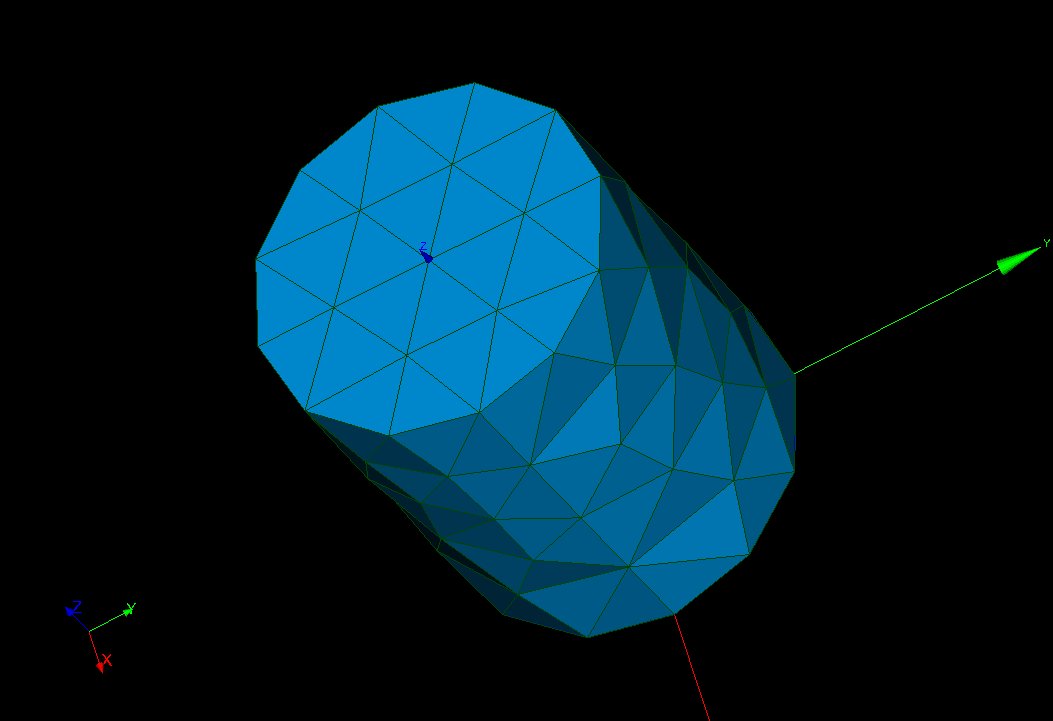
Computed mesh
Exporting the Mesh
- Verify boundary groups: Check that the three boundaries have been automatically added to the "Group of Faces" of the Mesh_1 object in the Object Browser
- Export to MED format:
- Select "Mesh_1"
- Right Click → Export → MED file (or File → Export → MED file)
- Save as Mesh_1.med
Reading the Mesh with TRUST
Create a TRUST data file named dom.data:
dimension 3
domaine dom
Read_MED { domain dom file Mesh_1.med }
Postraiter_domaine { domaine dom fichier mesh format lata }
Run TRUST and visualize with VisIt:
trust dom
visit -o mesh.lata
Warning: A common mistake is forgetting to define boundary groups for the geometry. TRUST will detect this during discretization when building all mesh faces, including boundary faces.
Refining the Mesh with Viscous Layers
To improve mesh quality near walls, viscous layers can be used:
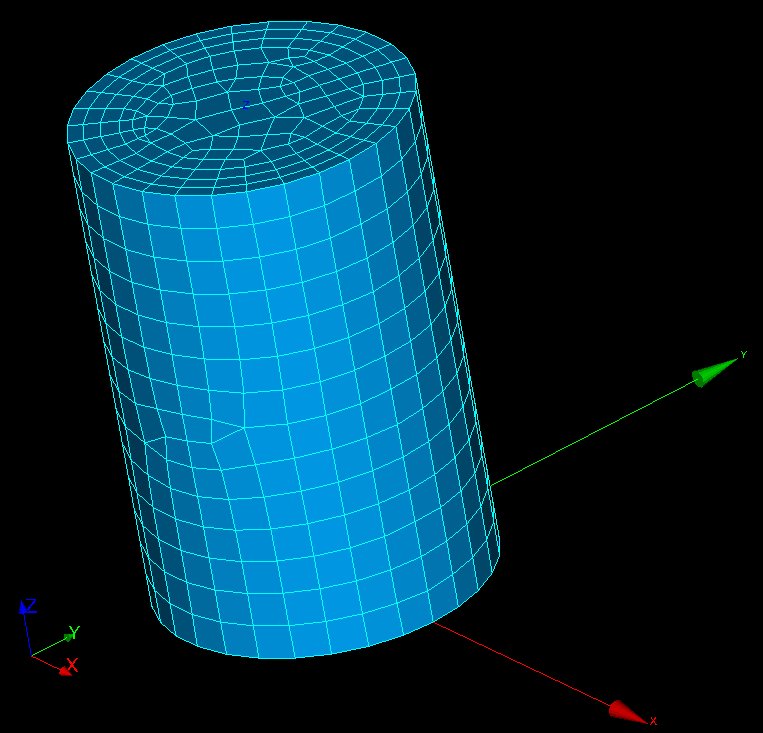
Refined mesh comparison
The resulting mesh will contain a mix of tetrahedral, hexahedral, pyramid, and prism elements (for Netgen) or tetrahedral and prism elements (for MG algorithms).
Converting to Tetrahedral Elements
Since TRUST only accepts tetrahedral elements:
- Select "Refined_Mesh" in the Object Browser
- Go to: Modification → Split Volumes
- Select "Tetrahedron"
- Keep the default parameters
- Click "Apply and Close"
Final Steps
- Verify boundaries: Check that the three boundaries are listed under "Group of Faces" of Refined_Mesh
- Export the mesh:
- Select "Refined_mesh"
- Right Click → Export → MED file
- Save as Refined_Mesh.med
- Save your work:
- HDF format: File → Save/Save As...
- Python format: File → Dump Study...
Note: Solution files (mesh.py for the first mesh and prism.py for the refined mesh) are available at: $TRUST_ROOT/docs/exercices/salome

 1.16.1