
VEF#
Initially introduced in [Liu and McCormick, 1989], Volume Element Finis -VEF- (Finite Volume Element) method is a variant of the standard finite element and finite volume methods. The formalism developed in [Emonot, 1992] was subsequently used for the implementation of this method in the TRUST code.
Finite Volume Element method#
Core Idea#
First, let’s consider the following instationary problem, with the velocity \(\boldsymbol{u}\) a flux term \(\boldsymbol{F}\) and a source term \(\boldsymbol{S}\).
We also introduce the control volume \(\omega_f\) (see Figure Figure 9) in which we want to evaluate the velocity \(\boldsymbol{u}\). We integrate on \(\omega_f\) between the times \(t^n\) and \(t^{n+1}\), regardless the regularity of \(\boldsymbol{u}\) and \(\boldsymbol{F}\). We also introduce a pressure p.
The expression of the flux term depends on the equation : \(\boldsymbol{F} = \mu \nabla \boldsymbol{u} - p\boldsymbol{I}\) for Stokes equation and \(\boldsymbol{F} = \mu \nabla \boldsymbol{u} - p\boldsymbol{I} + \rho \boldsymbol{u} \otimes \boldsymbol{u}\) for Navier-Stokes equation.
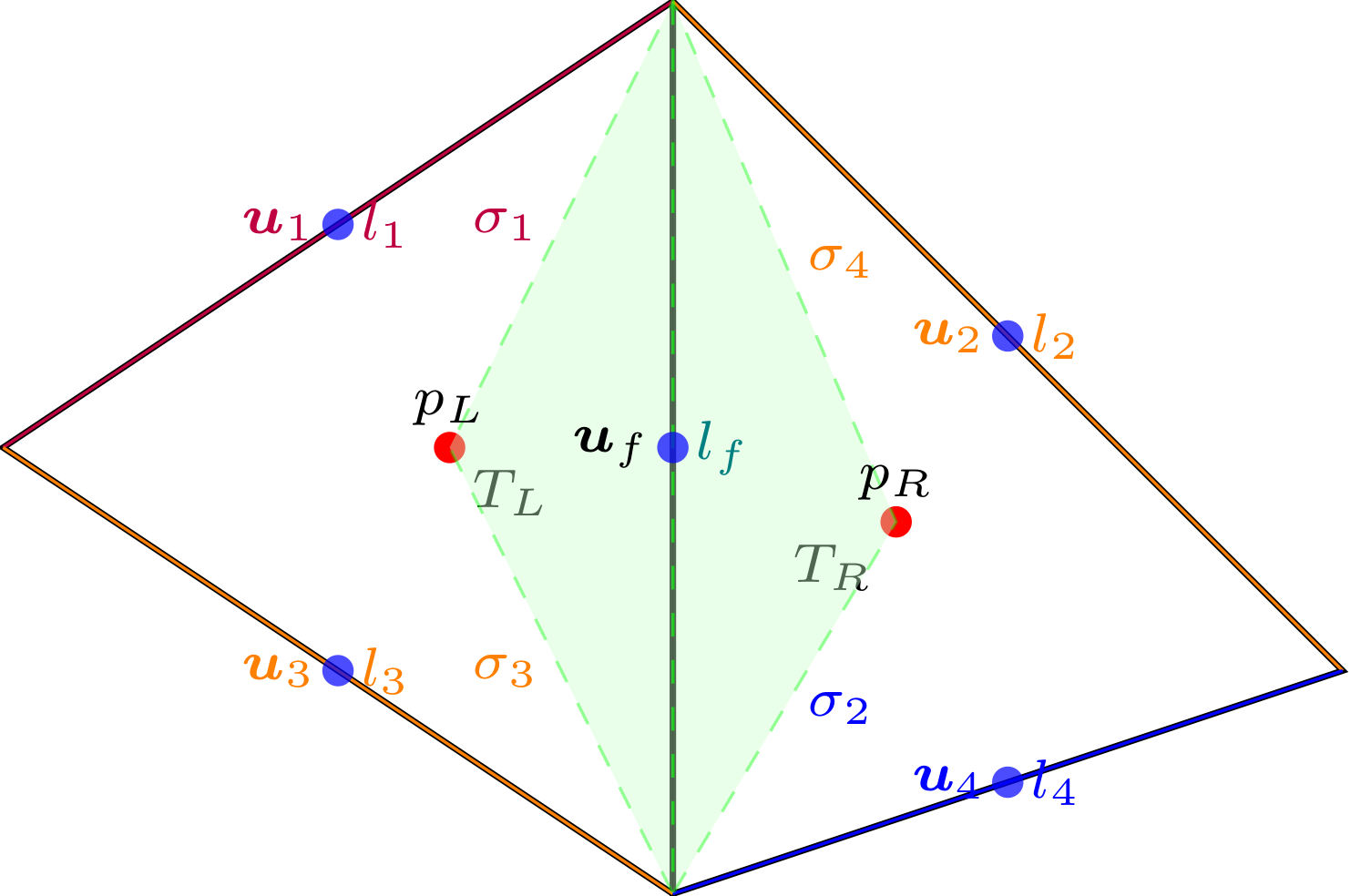
Figure 9 Control volume for velocity#
Finite Volume Approach#
Given a tetrahedral mesh \(\mathcal{T}_h\), we define the points \(\boldsymbol{x}_f\) as the barycentric center of the face \(f\). The control volume \(\omega_f\) is the polygon which links the vertex of the face \(\boldsymbol{f}\) with the barycenters of the two tetrahedron that share the face \(\boldsymbol{f}\). Let \(\boldsymbol{u}_f^m\) be the approximation of the velocity \(\boldsymbol{u}\) at the node \(\boldsymbol{x}_f\) and \(\Delta t^{n,n+1} \boldsymbol{S}_f^{n, n+1}\) the approximation of the right side hand term. Let’s discretize the evolution term such that :
Let’s pose \(\boldsymbol{F}^m = \boldsymbol{F}(t^n)\) or \(\boldsymbol{F}(t^{n+1})\) or of combination of the two depending on the time scheme choosen. The discretization of the flux term leads to the following equation.
The discretization of the equation (5) becomes :
At this point, the discretization method looks like a Finite Volume scheme. The main difference comes from the way the term \(\boldsymbol{F}^m_{T}\) is discretized with the help of Finite Element basis.
Finite Element Basis#
Historically, the VEF method was presented with the Crouzeix-Raviart basis. The full vector of the velocity is evaluated at the center of the faces of each tetrahedron. Within each cell, the pressure is a constant evaluated by its value at the center of the cell. Let’s pose \((\phi_f)_{f\in \mathcal{I}_{\text{f}}}\) the velocity basis (i.e. \(\phi_f(\boldsymbol{x_{f'}}) = \delta_{f,f'}\)) and \((\mathbb{I}_{K_k})_{k\in {\mathcal{I}_K}}\) the pressure basis (see Figure 10). Each discrete velocity vector \(\boldsymbol{u}_h\) and pressure \(p_h\) can be expressed with the following linear combination.
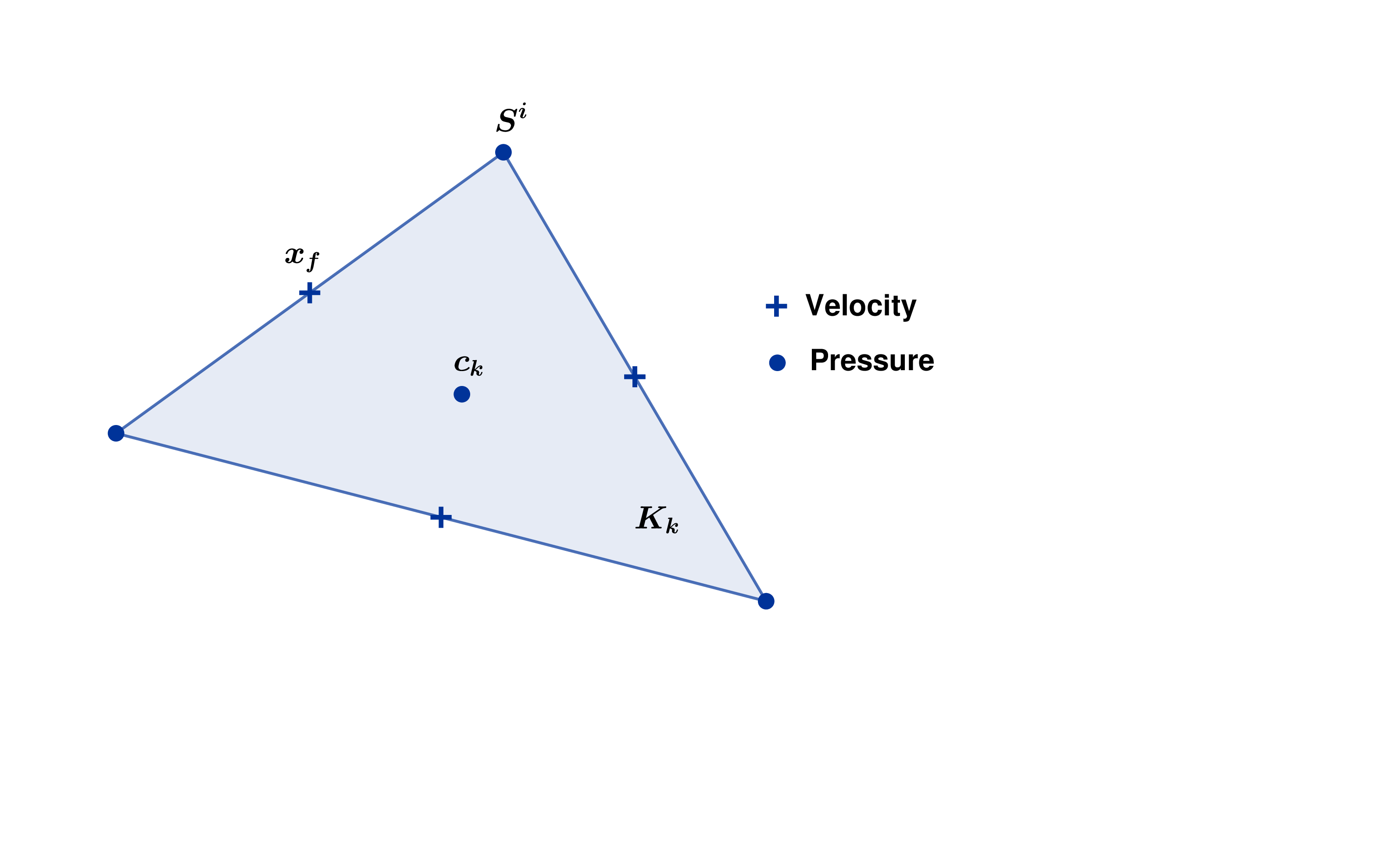
Figure 10 Control volumes for VEF-P0#
Discretization of the flux term in the Stokes equation#
For the Stokes equation, the flux term is \(\boldsymbol{F} = \mu \nabla \boldsymbol{u} - p\boldsymbol{I}\). Integrating on \(\partial\omega_f\), the discretization can be written with the finite element basis :
Note that the finite element basis \((\phi_f)_{f\in \mathcal{I}_f}\) can be express with the help of barycentric coordinate (see [Crouzeix and Raviart, 1973]) and its gradient is constant per tetrahedron: \((\nabla\phi_f)_T = \frac{1}{|T|}\int_{\partial T} \boldsymbol{n}d\boldsymbol{s}\) (see [Emonot, 1992], p27).
Thus, the discrete gradient of the velocity writes:
with :
and the pressure part :
Variational Formulation of the Stokes problem#
Let us introduce \(\mathbb{X}_h\) the finite element space for discrete velocities \(\boldsymbol{u}_f\) and \(\mathring{\mathbb{N}}_h\) for the discrete pressure. Then, we obtain the following VEF variational formulation by multiplying the mass conservation by a test pressure function \(q_h = \underset{k \in \mathcal{I}_K}{\sum} q_k \mathbb{I}_{K_k}\) and the momentum conservation by a test velocity function \(\boldsymbol{v}_h = \underset{f \in \mathcal{I}_{\text{f}}}{\sum} \boldsymbol{v}_f \phi_f\).
Find \((\boldsymbol{u}_h, p_h) \in \mathbb{X}_h \times \mathring{\mathbb{N}}_h\) such that:
with:
This formulation looks like finite element variational formulation.
Mathematical properties#
according to [Heib, 2003], there are two methods for analyzing the scheme based on the formulation (6):
The first involves directly analyzing the scheme. It enables to prove the uniform continuity of the bilinear forms, the ellipticity of \(a_h^V\), and establishing the inf-sup conditions.
The second involves demonstrating the equivalence of assembly matrices derived from FEM and VEF for the same given functional spaces. Thus, numerical scheme can be analyze with the FEM formalism which is well-known for Navier-Stokes equation with Crouzeix-Raviart elements (see [Crouzeix and Raviart, 1973]).
Using these equivalence properties, the Finite Volume Element scheme satisfies the FEM properties:
Inf-sup condition: Ensures the stability of the numerical scheme.
Continuity at edge midpoints: Implies weak continuity of velocity and enforces local mass conservation, leading to a divergence-free condition in each cell.
Well-posedness of the discrete problem: Guarantees the existence and uniqueness of the discrete solution.
Convergence rate for pressure: The pressure approximation converges with order 1 in the \(L^2\) norm.
Convergence rate for velocity: The velocity approximation converges with order 2 in the \(\boldsymbol{L^2}\) norm, provided that \(\Omega\) is convex.
A summary of the Crouzeix-Raviart FEM properties is presented in [Brenner, 2014]. However parasite currents for low velocities can appear when using the VEF approach, see [Fortin, 2006].
New Finite element basis#
In order to reduce parasite currents (usefull for low viscosities), a pressure enriched basis was studied in [Heib, 2003] and [Fortin, 2006] and implemented in TRUST code under the name VEF - \(\mathbb{P}^{nc}/\mathbb{P}^0+\mathbb{P}^1\). The idea is to add pressure unknows \(\mathbb{P}^1\) at the vertices of each cell. This add a new control volume for the mass conservation. Figure 10 represents the two control volumes for the two pressure unknows:
\(K_k\) for the constant part of the pressure which is \(\mathbb{P}^0\)
\(\Pi_{S^i}\) for the \(\mathbb{P}^1\) part associated with the unknown located at the center of vertex \(S^i\).
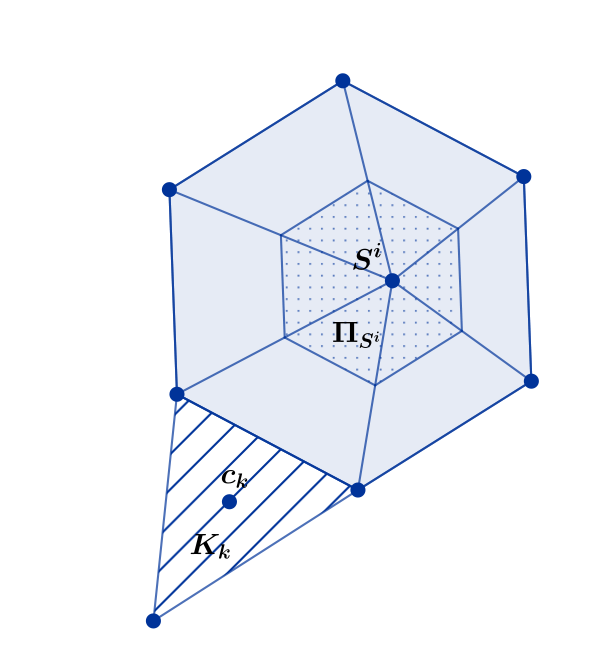
Figure 11 Control volume for pressure P0 and P1#
The stability of this new finite element basis is proved in [Jamelot et al., 2023] and the inf-sup condtion in [Fortin, 2006]. This scheme is the most used VEF discretization in TRUST.