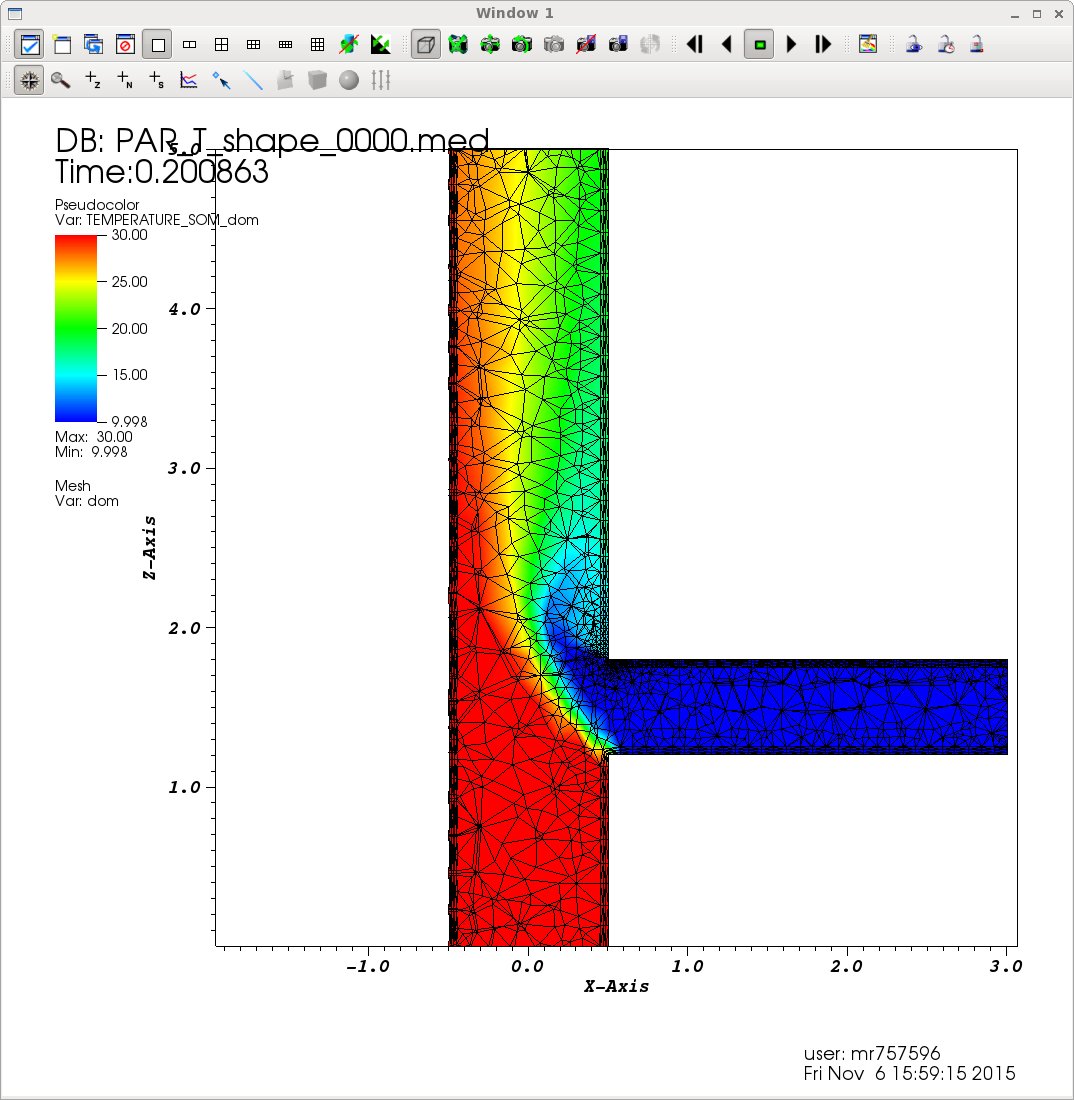
T-Shape#
This example demonstrates creating a T-shaped geometry using boolean operations.
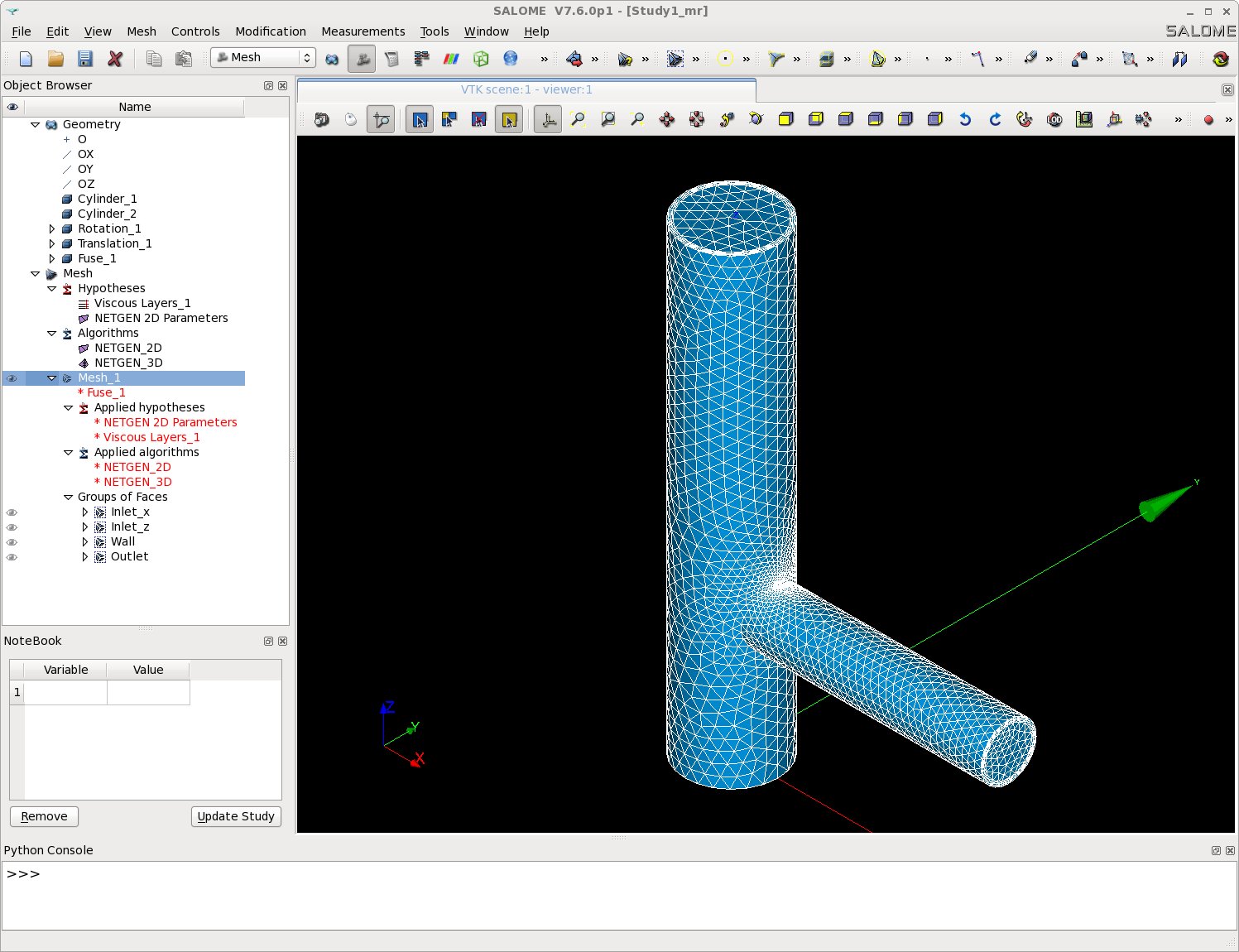
Setup#
mkdir -p TRUST_tutorials/salome/exo3
cd TRUST_tutorials/salome/exo3
$PathToSALOME/salome &
Create a new study: File → New
Select the Geometry module
Save frequently in HDF format
Creating the Base Cylinders#
Create two cylinders: New Entity → Primitives → Cylinder
Cylinder_1: Radius
0.5, Height5→ “Apply”Cylinder_2: Radius
0.3, Height3→ “Apply and Close”
Positioning the Second Cylinder#
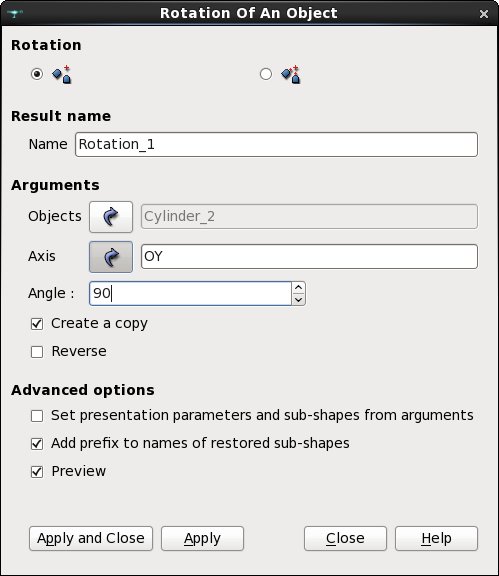
Rotate Cylinder_2: Operations → Transformation → Rotation
Name:
Rotation_1Object: Cylinder_2
Axis: OY
Angle:
90°Click “Apply and Close”
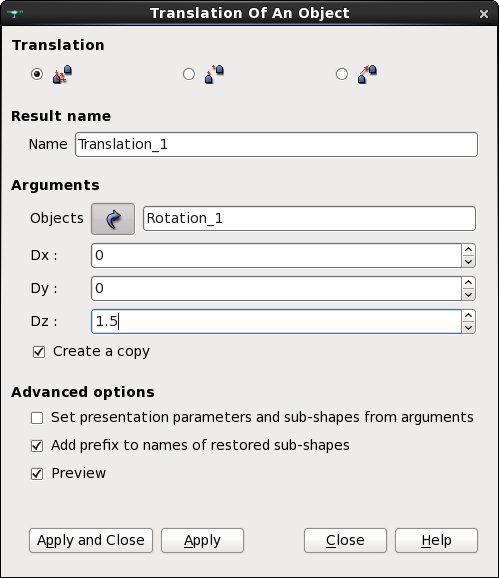
Translate the rotated cylinder: Operations → Transformation → Translation
Name:
Translation_1Object: Rotation_1
Dx = 0, Dy = 0, Dz = 1.5
Click “Apply and Close”
Fusing the Cylinders#
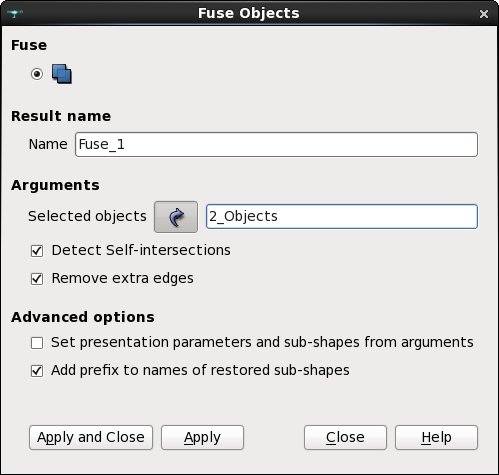
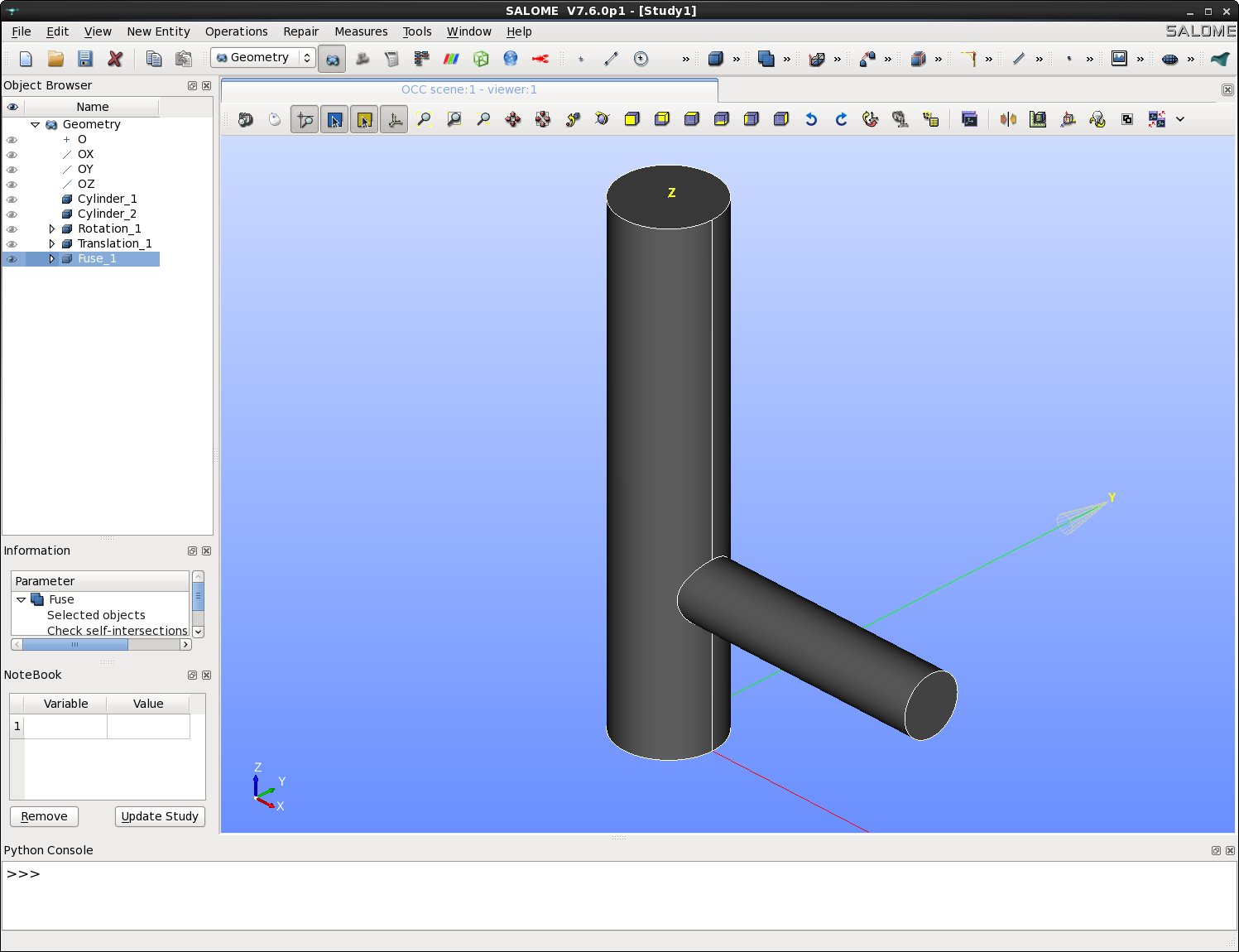
Combine the cylinders: Operations → Boolean → Fuse
Name:
Fuse_1Selected Objects: 2 objects (use “Ctrl” to select both Cylinder_1 and Translation_1)
Click “Apply and Close”
Creating Boundaries#
Extracting Individual Faces#
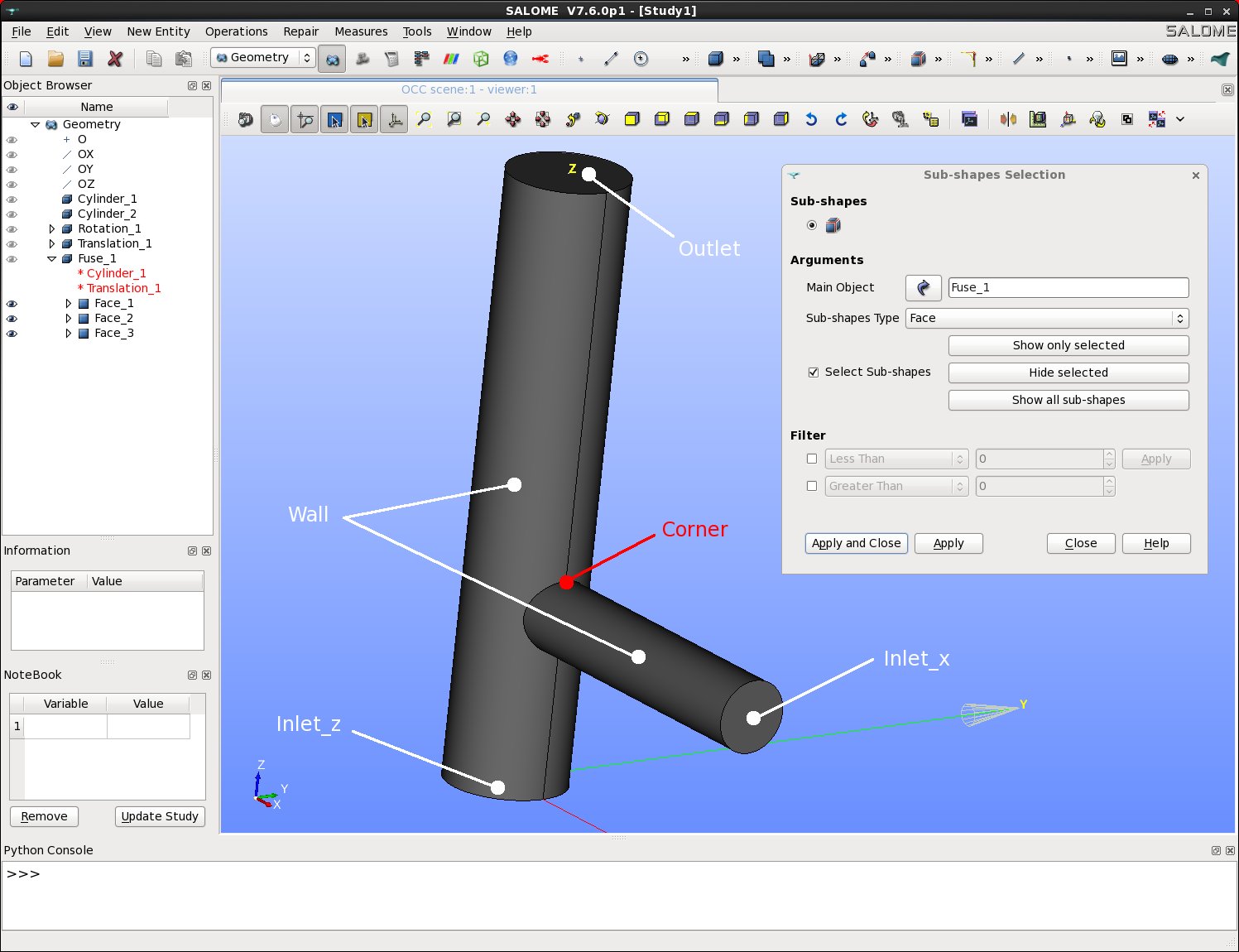
For each outlet/inlet face:
Extract faces: New Entity → Explode
Main Object: Fuse_1
Sub-shape type: Face
Select “Select sub-shape”
Click on the desired surface in the visualization window
Click “Apply”
Rename the face:
The face will be created as “Face_1” under Fuse_1
Right-click and select “Rename”
Rename to:
Outlet,Inlet_x, orInlet_z
Creating the Wall Group#
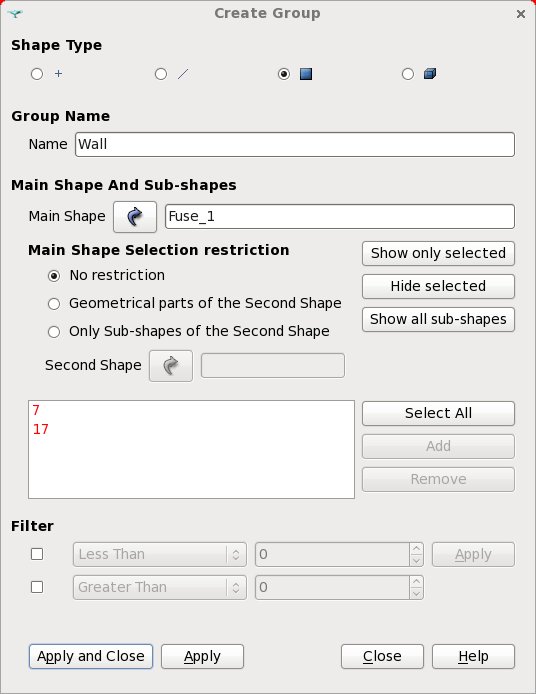
Create a surface group: New Entity → Group → Create Group
Shape Type: Surface
Name:
WallMain Shape: Fuse_1
Click on the lateral surface of Cylinder_1 → “Add”
Click on the lateral surface of Translation_1 → “Add”
Click “Apply and Close”
Creating a Corner Point#
This point will be used for local mesh refinement:
Extract a vertex: New Entity → Explode
Main Object: Fuse_1
Sub-shape type: Vertex
Select “Select sub-shape”
Click on the chosen corner point
Click “Apply and Close”
Rename: Rename “Vertex_1” to
Corner
Creating the Mesh#
Switch to the Mesh module from the drop-down menu
Display the geometry:
Select “Fuse_1” in the Object Browser
Right Click → ‘Show’ (or click the eye icon)
Create the mesh: Mesh → Create Mesh
Select “Fuse_1” as the geometry
Configure the 3D algorithm: Choose “Netgen 3D”
Add viscous layers:
Click the wheel icon next to “Add. Hypothesis” → “Viscous Layers”
Total thickness:
0.05Number of layers:
3Stretch factor:
1.1Extrusion method: Node Offset
Add the “Wall” group to “Faces with layers (Wall)”
Click “OK”
Configure the 2D algorithm: Choose “Netgen 1D-2D”
Set 2D parameters:
Click the wheel icon next to “Hypothesis” → “Netgen 2D parameters”
Arguments menu:
Max. Size:
0.6Min. Size:
0Fineness: Custom
Growth rate:
0.1Nb. segs per Edge:
2Nb. segs per Radius:
4☑ Limit size by Surface Curvature
☑ Optimize
☐ Allow Quadrangles
☐ Second Order
Local Size menu:
Select the “Corner” object in the Object Browser
Click “On Vertex”
Set value to
0.01
Advanced menu:
☑ Fuse Coincident Nodes on Edges and Vertices
Click “OK”
Apply and compute:
Click “Apply and Close”
Select “Mesh_1”
Right Click → Compute
Converting to a Tetrahedral Mesh#
Select “Mesh_1” in the Object Browser
Go to: Modification → Split Volumes
Select “Tetrahedron”
Keep the default parameters
Click “Apply and Close”
Exporting and Saving#
Verify boundaries: Check that all four boundaries appear under “Group of Faces” of Mesh_1
Export the mesh:
Select “Mesh_1”
Right Click → Export → MED file
Save as
Mesh_1.med
Save the study:
HDF format: File → Save/Save As…
Python format: File → Dump Study…
Note
The solution file (T_shape.py) is available at: $TRUST_ROOT/doc/TRUST/exercices/salome
Running with TRUST#
Copy and run the TRUST data file:
cp $TRUST_ROOT/doc/TRUST/exercices/salome/T_shape.data .
trust T_shape
Or run in parallel:
trust -partition T_shape
trust PAR_T_shape 4
Visualize the results with VisIt or SALOME by opening:
Sequential:
T_shape_0000.medParallel:
PAR_T_shape_0000.med